Entrons · Position Paper
The Sleeping Fleet
Why the world's largest robot fleet is asleep, and how we wake it.
1. Introduction
Industrial manufacturing in high-wage economies is under pressure from three directions at once. Skilled labour is becoming scarce. The experienced machine operators and process specialists are retiring faster than they are replaced. In many niche processes, critical decision-making competence rests with a handful of individuals. Cost pressure is rising, and quality requirements are tightening at the same time. The result is a growing misalignment between the productivity expected from industrial assets and the human expertise available to achieve it.
It is widely assumed that modern automation has already addressed this misalignment by enabling contemporary production machines to operate autonomously without human involvement. We argue that this is a misconception. State-of-the-art industrial automation executes predefined logic and does not adapt when conditions fall outside the range foreseen by its designers; it simply continues to execute its predefined logic or stops. Autonomy holds up only while the process stays inside an anticipated scope.
Across industrial production, the complexity of processes makes exhaustive rule specification impractical. This applies to the full breadth of powered production machinery and industrial process types: machines that form material, such as presses, straightening machines, rolling mills, and bending or drawing lines; machines that remove material, such as grinding, milling, and turning machines; machines that treat surfaces, such as coating and finishing machines as well as industrial cleaning systems. Further examples include fluid-, gas-, and solid-body handling systems for dosing, mixing, pumping, and filtering, and other processes. In these processes, the variety of possible scenarios is almost infinite. Although these machines differ greatly in their physical mechanisms, their robust operation frequently depends on human supervision and intervention. This remains necessary because human experience enables operators to evaluate and manage the broad range of scenarios that may arise in these processes. It becomes particularly important in unforeseen scenarios or when operating conditions fall outside the range anticipated by the automation system.
The human response to a particular process scenario begins with perception. Operators continuously observe and interpret the state of a machine and its environment in order to act according to process requirements. This perception is rarely absolute in a metrological sense; it is relational. They recognise that the process is behaving differently from normal, that its current state no longer matches the expected one, or that "something is drifting" before any automation threshold is reached. This forms part of a perception-action loop: the perceived deviation calls for a response, and that response is drawn from experience. Polanyi[1] termed this form of competence tacit knowledge: "we can know more than we can tell." Like a cyclist who cannot fully state the principles by which balance is maintained, an operator may be unable to articulate how they recognise that a process is drifting, yet may still do so reliably. Moreover, this perception-action loop improves with experience. More experienced operators perceive weaker signals, interpret them faster, and select the appropriate action more reliably. This allows them to handle a broad variety of scenarios including the long tail of rare ones. This leads to a central proposition of this paper: the robust operation of industrial processes depends on human perception-action loops.
Current industrial AI only partially captures specialists' tacit knowledge and domain expertise[2]. One dominant line of work[3] focuses on systems that reproduce aspects of human physical labour, including humanoid robots and other robotic manipulators. As external actors, they position parts, tend machines, and exchange components from outside the production asset. However, they are insufficient when processes operation requires more than physical manipulation and depends on human reasoning and decision-making. Another line of work[4] processes existing machine data which is still insufficient for describing human reasoning and decision-making. These methods evaluate PLC variables, alarm logs, currents, and quality records, but do not capture the profound knowledge of operators and process specialists. Neither line addresses the operator's actual role. Data-driven analysis evaluates process variables but excludes the operator's perception and understanding of the process. An external robot can reproduce the operator's keystrokes at the control panel, while still lacking the reasoning and judgement to determine exactly which keystrokes to make.
Our approach is fundamentally different. We leverage the fact that an industrial production machine already possesses a body, actuators, force, kinematics, a safety architecture, and the ability to directly affect the process. What it lacks, however, is the ability to perceive its own process and a model of the experiential judgement by which that process is steered. We therefore propose to add this missing layer to the industrial machine itself. We call the resulting sub-category of Physical AI "Advanced Industrial Machines": systems in which intelligence is not placed outside the industrial machine, but embedded within it. This is achieved by giving the installed asset its own perception, the ability to judge, and an interface to its degrees of freedom. The aim is not to place a robot beside the machine, but to transform the industrial machine itself into a robot.
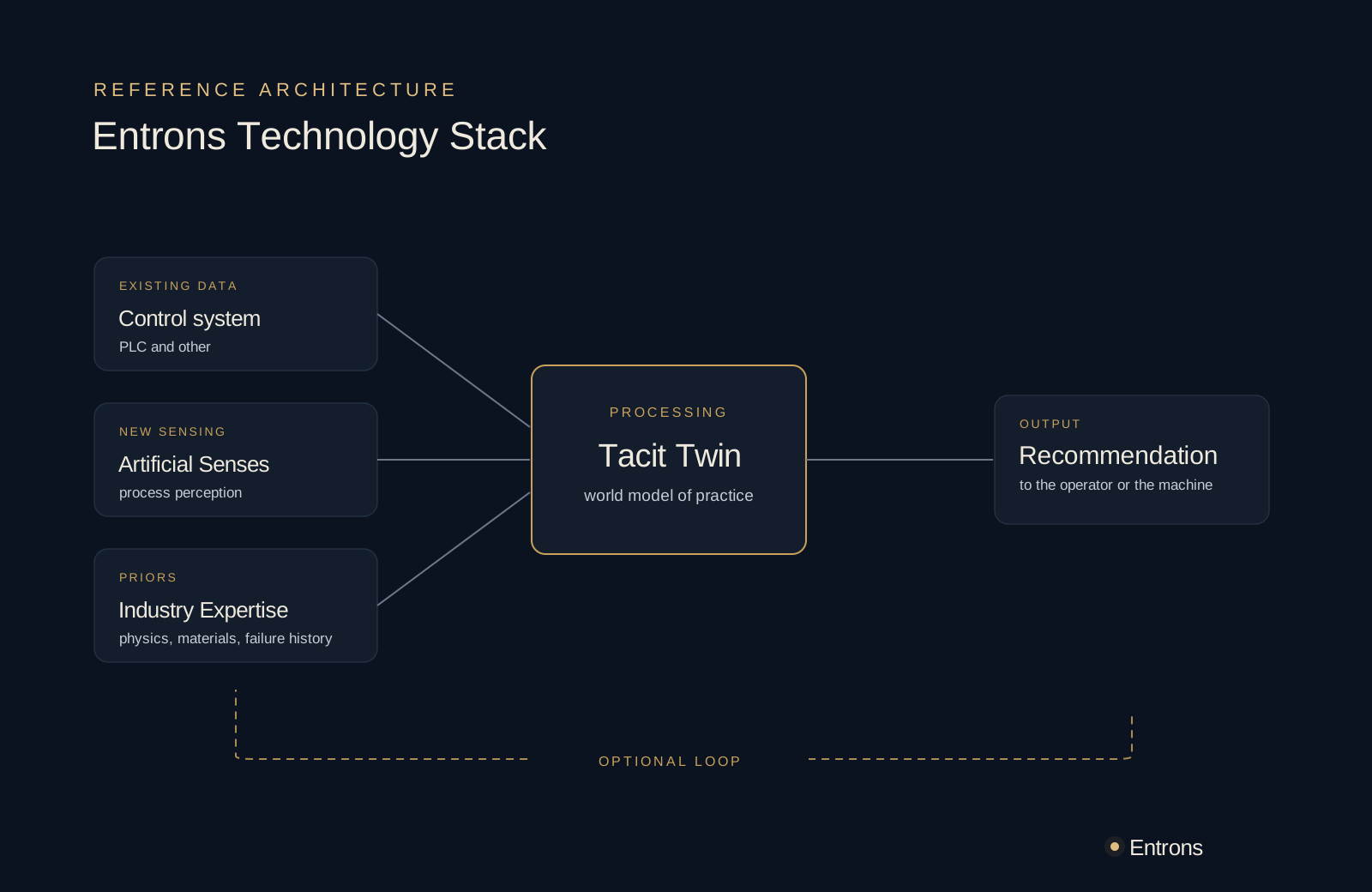
We propose to achieve this technological shift — from intelligence positioned outside the machine to intelligence embedded within it — through three components: Artificial Senses, Tacit Twin, and Industry Expertise. Artificial Senses comprises an extended set of sensors that capture raw input from multimodal, process-near information channels. This combined input makes process-relevant changes machine-perceivable in a manner analogous to expert perception. The Tacit Twin is an industrial world model that models the expertise of operating the industrial machine across a wide range of scenarios. It represents operators' procedures and judgements, recognition of recurring process patterns, and learned correlations between signals, process states, intervention requirements, and process outcomes. Industry Expertise represents domain knowledge that serves as a foundation for reasoning beyond established routines. It captures the knowledge of process physics, material behaviour, and environmental conditions as well as the recorded history of machine-class failures and recoveries. In other words, it is the combined knowledge that a range of process specialists draw upon. Together these three components give the industrial machine perception, judgement, and the ability to act appropriately across a wide range of real-world scenarios.
The installed base of industrial machinery is the largest dormant robot fleet in the world. It is dormant not because it lacks a body, but because it lacks sufficiently rich senses, contextual understanding, and situational judgement. In this paper, we define this sub-category of Physical AI and its constitutive criteria, introduce a reference architecture for realising it, outline initial pilot designs, and examine the open questions of validation, transferability, safety, and data ownership raised by its development.
References
- [1]Polanyi, Michael. The Tacit Dimension. Chicago: University of Chicago Press, 2009 [1966], p. 4.
- [2]Fenoglio, Enzo, Emre Kazim, Hugo Latapie, and Adriano Koshiyama. "Tacit Knowledge Elicitation Process for Industry 4.0." Discover Artificial Intelligence 2, no. 1 (2022): 6.
- [3]Billard, Aude, and Danica Kragic. "Trends and Challenges in Robot Manipulation." Science 364, no. 6446 (2019): eaat8414.
- [4]Leukel, Joerg, Julian González, and Martin Riekert. "Adoption of Machine Learning Technology for Failure Prediction in Industrial Maintenance: A Systematic Review." Journal of Manufacturing Systems 61 (2021): 87–96.
[ … ]
The full paper will be published later this year.